First Pakistan India War (1947–1948)
The Indo-Pakistani war of 1947–1948, also known as the first Kashmir war, was a war fought between India and Pakistan over the princely state of Jammu and Kashmir from 1947 to 1948. It was the first of the four Indo-Pakistani wars.
The Indo-Pakistani war of 1947–1948 started with a rebellion in Poonch against the heavy handed actions of Maharaja of Kashmir, Hari Singh.
Rebellion in Poonch:
During the Second World War, over 60,000 men from Poonch and Mirpur districts enrolled in the British Indian Army. After the war, they were discharged with arms, which is said to have alarmed the Maharaja. As a consequence, in July 1947 the Maharaja ordered that all the soldiers in the region be disarmed.
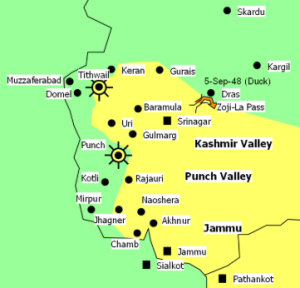
This act of Maharaja, coupled with the absence of employment prospects and high taxation drove the Poonch residents to rebellion. Additionally, the local Muslim Conference led by Sardar Muhammad Ibrahim Khan (Sardar Ibrahim) was already running a campaign for accession to Pakistan.
An unfortunate incidence happened when hundreds of people were killed in Bagh during a flag hoisting ceremony around 15th August. Situation was further aggrevated when Maharaja unleashed a ‘reign of terror’ on 24th August. The army fired on crowds, and burnt houses and villages indiscriminately.
The rebellion in Poonch unnerved the Maharaja. On 25th August, he sent an invitation to Justice Mehr Chand Mahajan of the Punjab High Court to join as the Prime Minister.
On the same day, the Muslim Conference wrote to the Pakistani Prime Minister Liaquat Ali Khan warning him that:
“if, God forbid, the Pakistan Government or the Muslim League do not act, Kashmir might be lost to them”.
Pakistan’s help for Kashmiris:
This set the ball rolling in Pakistan. Pakistan cut off essential supplies to Kashmir, such as petrol, sugar and salt. It also stopped trade in timber and other products, and suspended train services to Jammu.
Meanwhile, Sardar Ibrahim had escaped to West Punjab, along with dozens of rebels, and established a base in Murree. Colonel Akbar Khan of Pakistani Army arrived in Murree to help Sardar Ibrahim. He arranged 4,000 rifles for the rebellion by diverting them from the Army stores.
On 12th September, the Prime Minister held a meeting with Colonel Akbar Khan and two important politicians of Punjab, Sardar Shaukat Hayat Khan and Mian Iftikharuddin. Sardar Shaukat Hayat Khan proposed an additional plan, involving the Muslim League National Guard and the militant Pashtun tribes from the Frontier regions. The Prime Minister approved both the plans, and despatched Khurshid Anwar, the head of the Muslim League National Guard, to mobilise the Frontier tribes.
On 22nd October 1947, Maj. Khurshid Anwar entered Kashmir near Muzaffarabad heading a lashkar of 4,000 tribesmen.
The first clash between rebels and Maharaja troops is said to have occurred at Thorar (near Rawalakot) on 3–4th October 1947. The lashkar gained control of almost the entire Poonch district. The State Forces garrison at the Poonch city came under heavy siege. In the Poonch valley, the state forces retreated into towns where they were besieged.
The state forces stationed in the border regions around Muzaffarabad and Domel were quickly defeated by the tribal forces. Muslims in the state forces mutinied and joined the lashkar. So, the way to the capital Srinagar was open.
Rather than advancing toward Srinagar before state forces could regroup or be reinforced, the lashkar remained in the captured cities in the border region engaging in looting.
Accession of Kashmir to India:
Following the rebellions in the Poonch and Mirpur area and the Pakistan-backed Pashtun tribal invasion from the North-West Frontier Province, the Maharaja asked for Indian military assistance.
India set the condition that Kashmir must accede to India to receive assistance. The Maharaja complied, and the Government of India recognised the accession of the princely state to India. Indian troops were sent to the state to defend it. The Jammu & Kashmir National Conference volunteers (led by Sheikh Abdullah) aided the Indian Army in its campaign.
Indian operation in the Kashmir Valley:
After the accession, India airlifted troops and equipment to Srinagar, established a defence perimeter and defeated the tribal forces on the outskirts of the city.
Maj. Khurshid Anwar and some of the tribesmen advanced again, and about 1,000 of them reached Budgam
by 3rd November, which was within striking distance of the Srinagar airfield. Here they were confronted by Indian troops who defeated them. The Indian troops recaptured Baramulla and Uri.
However, in the Poonch valley, tribal forces continued to besiege state forces. Indian forces tried to recapture Poonch but failed. Mirpur was captured by the tribal forces on 25th November 1947 with the help of Pakistan’s Cavalry.
Pakistan’s entry in the war:
Pakistan refused to recognise the accession of Kashmir to India, claiming that it was obtained by “fraud and violence.”
Quaid e Azam ordered his Army Chief General Douglas Gracey to move Pakistani troops to Kashmir at once.
However, the Indian and Pakistani forces were still under a joint command, and Field Marshal Auchinleck prevailed upon him to withdraw the order.
This delay was critical. If Pakistan Army had entered the war at this stage, Kashmir would have been liberated.
In May 1948, the Pakistan Army officially entered the conflict to defend the Pakistan borders. But it also planned to push towards Jammu and cut the lines of communications of the Indian forces in the Mehndar Valley.
At 23.59 hrs on 1 January 1949, a United Nations-mediated ceasefire came into effect, to bring the war to an end.
Aftermath:
The terms of the ceasefire, were adopted by the UN commission on 5th January 1949. This required Pakistan to withdraw its forces, both regular and irregular, while allowing India to maintain minimal forces within the state to preserve law and order.
Upon compliance with these conditions, a plebiscite was to be held to determine the future of the territory.
However, owing to disagreements over the demilitarisation steps, a plebiscite was never held.
Pakistan was able to get control of much larger area than India could. The combined area of Azad Kashmir and Gilgit Baltistan is more than 3 times that of Occupied Kashmir.
India and Pakistan signed the Karachi Agreement in July 1949 and established a ceasefire line to be supervised by observers.
References:
Schofield, Victoria(2003) [2000]. Kashmir in Conflict. London and New York: Taurus & Co. ISBN1-86064-898-3.
State, Community and Neighbourhood in Princely North India, c. 1900–1950, By I. Copland.
Palgrave Macmillan. 26 April 2005. p. 143. ISBN 978-0-230-00598-3.
Raghavan, Srinath (2010). War and Peace in Modern India. Palgrave Macmillan. pp. 101–.
Nawaz, Shuja (May 2008), “The First Kashmir War Revisited”, India Review, 7(2): 115–154, doi:1080/14736480802055455, S2CID 155030407
Copland, Ian (2005). State, Community and Neighbourhood in Princely North India, c. 1900–1950.
Palgrave Macmillan UK. p. 143. ISBN978-0-230-00598-3.
https://en.wikipedia.org › wiki › Indo-Pakistani_war_of 1947-48.
R